February 1, 2017
Peer review at Am Nat
At the American Naturalist, our goal is to help papers develop. We try to give feedback even to papers that aren't a great fit for Am Nat. But we especially try to work with papers that can fit our niche to help them become the best they can be. We appreciate so much the time our reviewers take to be careful and thorough and helpful. Sometimes this aspect gets lost in discussions of peer review, so we're glad when we get positive feedback like the letter below when the author got news of the manuscript's acceptance (posted with permission).
Dear Dr. Winn,
Many thanks - this really is exciting news! ...
If you think it would be appropriate, I'd very much appreciate if you could send on the following note to Dr. Collar and to the two reviewers who commented on this manuscript. I'm always a bit hesitant to be too complimentary towards editors and reviewers during the review process for fear that it will appear that I'm trying to butter them up, but now I really want to express how grateful I am to them, and to the editorial structure at AmNat.
While most of our colleagues responded positively to the topic when we passed an early draft of the manuscript around for "friendly review", we found it difficult to get much advice on what we needed to do in order to improve it. The feedback that we got from the review process was immensely helpful in providing this. In particular, I cannot express how grateful I am for:
(1) the advice on how to address phylogenetic uncertainty that we received from Dr. Collar and from reviewer 2 (both in the reviews and in subsequent emails)
(2) the detailed description of missing links in our citations provided by reviewer 1, which importantly also included examples of papers that we could read in order to fill those gaps
and
(3) the very careful and specific critiques and suggestions for our modeling methods from reviewer 2, which made it clear that they had invested a lot of effort in going through them
But, I think the most important part of the review process for us was how incredibly encouraging the editors and reviewers were at all stages. Both of us are quite junior in our career trajectories, and while the opportunity for double-blind reviews gave us a bit more courage to "aim high" with this paper, I don't know that we would have considered ourselves capable of completing the suggested revisions without the very kind words that you, Dr. Collar, and the reviewers included at the beginning of each of your comments.
I think that the most genuine complement that I can give is that this manuscript simply wouldn't have been completed in its current state without all of this help and encouragement.
Many thanks again,
Adam Clark

August 3, 2016
Publish Your Best Work in Am Nat
PUBLISH
YOUR BEST WORK IN
THE AMERICAN NATURALIST
- 1. Be part of the lasting legacy of the most influential papers in your field. What journal published Hutchinson’s classic “Homage to Santa Rosalia,” Hairston, Smith, and Slobodkin’s “Community Structure, Population Control, and Competition” (“The World is Green”), or Paine’s “Food Web Complexity and Species Diversity”? What about Felsenstein’s “Phylogenies and the Comparative Method,” Hamilton’s “The Evolution of Altruistic Behavior,” or Wright’s “Coefficients of Inbreeding and Relationship”? American Naturalist papers shape the field with their extraordinary and lasting impact. Join the list!
- 2. Reach a broad audience. Articles are sought in any area of the biological sciences that touch on the natural world. Cutting-edge empirical and theoretical contributions both have a home in Am Nat, as does work using any method at any time scale, ranging from the ecological to the macroevolutionary. Whether your focus is population genetics, evolutionary genetics, or genomics; population, community, or ecosystem ecology; ecological or evolutionary dynamics; natural selection or sexual selection; behavior, ecophysiology, phylogenetics, or macroevolution, your paper will be given full consideration by an Associate Editor in your own field. Check out the Editorial Board and you’ll see!
- 3. Receive extraordinary attention for your work throughout the publication process. As an author, you deserve the best. The American Naturalist provides extensive and insightful reviews and editorial decisions; even authors whose work has been declined offer testimonials to the value of the feedback. The skill and professionalism of the entire editorial process lead authors to consider Am Nat the gold standard.
- 4. Support not-for-profit publishing. Contribute to one of the few top science journals still run in-house by an academic publisher! The University of Chicago Press, a not-for-profit division of the university, exists to assist researchers to achieve the highest-quality publications. The American Naturalist puts science before profit.
- 5. Support the American Society of Naturalists. A healthy journal fosters the ASN’s other activities: running outstanding stand-alone meetings, conferring awards such as the Young Investigator Prize and the Student Research Award, and maintaining a leadership role in advocacy of fair and egalitarian publishing practices. A healthy journal also keeps membership in the ASN low and affordable, especially for students.
- 6. Publish where costs are affordable—or at no cost! Itemized page charges mean that only processes needed for a particular manuscript are charged. No access to institutional funds? Then the ASN waiver covers all production charges (for the cost of membership if an author isn’t already a member--$20 for a student). E-articles mean color typesetting can be free. In every issue, papers are published at no cost to the authors.
- 7. Meet funder mandates for open access. In addition to itemized charges, Am Nat offers the kind of gold open access required by funders—with a CC-BY license and APCs. All articles also qualify for green open access (deposit in a repository after embargo).
- 8. Publish with a pioneer of innovative practices that benefit authors and the community at large. The U of C Press was one of the first to publish electronically. The mandate for open data in public archives (e.g., Dryad) was spearheaded by American Naturalist editors. To ensure that authors’ work is treated fairly regardless of gender or nationality or other implicit bias, Am Nat was among the first ecology and evolution journals to embrace double-blind reviewing. Independent of the dictates of a massive profit-making organization, The American Naturalist can respond nimbly to the times.
Does
your paper pose new and significant problems, introduce novel subjects, develop
conceptual unification, and change the way people think? Then send your manuscript to The
American Naturalist today!
March 9, 2016
Tools for Keeping an Eye on Am Nat
I wanted to point out some tools of the new website that should help readers. They can only be accessed after logging in, and, since most people access the website via an institutional subscription or with an open access article, they might not realize that these tools for keeping an eye on Am Nat exist.
The Log In link is on the top of the page.

This takes you to the log in page for Customer Service.

If you are a member/subscribe, you should use your subscriber information for the top log in where it asks for username and password.
You don't need a subscription to set up an account to access the tools. Type in an email address into the bottom form. It will let you know if you already have an account—if for instance you are already getting the email with the Table of Contents each month. It asks for a minimal amount of basic information. Once in, it tells you whether you have a subscription or not. The features that you can use are at the bottom of the menu on the left.
The Alerts Link allows you to set up an email that sends the Table of Contents each month when the issue as a whole posts.
 At the bottom of the TOC Alerts tab, there is the option for getting an email whenever an article posts on the Ahead of Print page. The options of Never, Daily, Weekly, or Monthly (though, since Am Nat *is* a monthly, that's not too helpful).
 Citation Alerts are on the second tab under Alerts. This tab allows you to delete existing citation alerts or check on which articles you have set up.

To set up a new citation alert, you click on the link at the top of the article you are reading.

The alert consists of an email telling you whenever a new publication has cited the article—as long as the publication is submitting its literature cited list to CrossRef. Unfortunately, there seem to be quite a few publishers who don't do that so this feature misses cites (as does the Cited By tab for articles) but it's an easy way to keep an eye on some of the publications on that topic. Here's what the email citation alert email looks like:

Saved Searches allows you to keep a focused eye on topics of interest in the journal. After a specific search (filtered by keywords, authors, time frame), save the search by clicking on the button.

It will ask you whether you want to get an alert when new items meeting the search criteria appear:
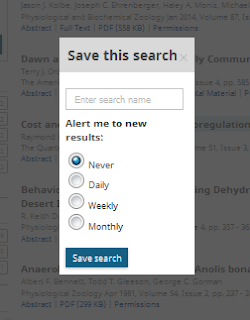
From the My Account page for Saved Searches, you can change the alert setting frequency or run the whole search over again and get all the available results.

Trish of the Naturalist
The Log In link is on the top of the page.

This takes you to the log in page for Customer Service.

If you are a member/subscribe, you should use your subscriber information for the top log in where it asks for username and password.
You don't need a subscription to set up an account to access the tools. Type in an email address into the bottom form. It will let you know if you already have an account—if for instance you are already getting the email with the Table of Contents each month. It asks for a minimal amount of basic information. Once in, it tells you whether you have a subscription or not. The features that you can use are at the bottom of the menu on the left.


To set up a new citation alert, you click on the link at the top of the article you are reading.

The alert consists of an email telling you whenever a new publication has cited the article—as long as the publication is submitting its literature cited list to CrossRef. Unfortunately, there seem to be quite a few publishers who don't do that so this feature misses cites (as does the Cited By tab for articles) but it's an easy way to keep an eye on some of the publications on that topic. Here's what the email citation alert email looks like:

Saved Searches allows you to keep a focused eye on topics of interest in the journal. After a specific search (filtered by keywords, authors, time frame), save the search by clicking on the button.

It will ask you whether you want to get an alert when new items meeting the search criteria appear:

From the My Account page for Saved Searches, you can change the alert setting frequency or run the whole search over again and get all the available results.

Trish of the Naturalist
Subscribe to:
Posts (Atom)